

Compare every bid against the same floor plan before you compare totals.
TLDR Comparing cabling bids for a tenant’s build-out or move-in in Santa Monica? Send every contractor the same floor plan. Ask each one to split out new and reused cables, materials, pathway work, testing and handoff. Before you compare totals, get an owner and a price for every exclusion.
Two bids can both say 40 drops. Only one may include a test on every cable. That gap shows up on move-in day, when the tenant’s IT team finds out which ports work.
This guide shows how to line up the bids so the totals cover the same work. It fits a tenant improvement (TI) project, a retrofit or a straight move-in. Use it with the tenant’s IT lead, who will care most about the certification reports.
Start with a marked-up floor plan and count each data drop. A two-port faceplate (the wall plate with two jacks) needs two drops if both jacks will be live. Ask each bidder to mark which cables are new, which are reused and which are optional. Then read the quotes row by row. If a line goes to another trade, write down who does that work and what it costs. On a build-out, that’s often the electrician or the general contractor (GC).
| Bid line | What to compare | What to clarify before signing |
|---|---|---|
| Endpoints and cable | New and reused cable counts, room or endpoint IDs, cable category, jack and patch-panel terminations | Whether a drop means one cable or one faceplate |
| Equipment and materials | Jacks, panels, patch cords, racks and cable management | Who supplies each item and which materials are optional |
| Pathways and access | Existing paths, risers, new supports or conduit, ceiling and telecom-room access, restoration | Who clears blocked pathways, gets riser and telecom-room access from the building, and restores finishes |
| Work hours and labor | Number of visits, approved work windows and after-hours labor | Whether the price assumes daytime access and how a return visit is priced |
| Testing and reuse | The test for each new cable and for each reused cable that will remain in service | Who replaces a failed reused cable and how that work is approved and priced |
| Handoff and exclusions | Port labels, updated drawings, cable-by-cable results, fees and work by other trades | Who delivers the files and who closes each excluded item |
If the job includes Wi-Fi access points, price three things separately: the cable run, mounting the device and setting up the wireless network. Different teams can own each one. If a floor needs a fiber cable back to the building’s main telecom room, price the fiber and its tests apart from the copper outlet count. For fiber, ask which loss test the contractor will run and what report you’ll get. Nascient wireless services · Nascient fiber services · Fiber Optic Association fiber testing guide
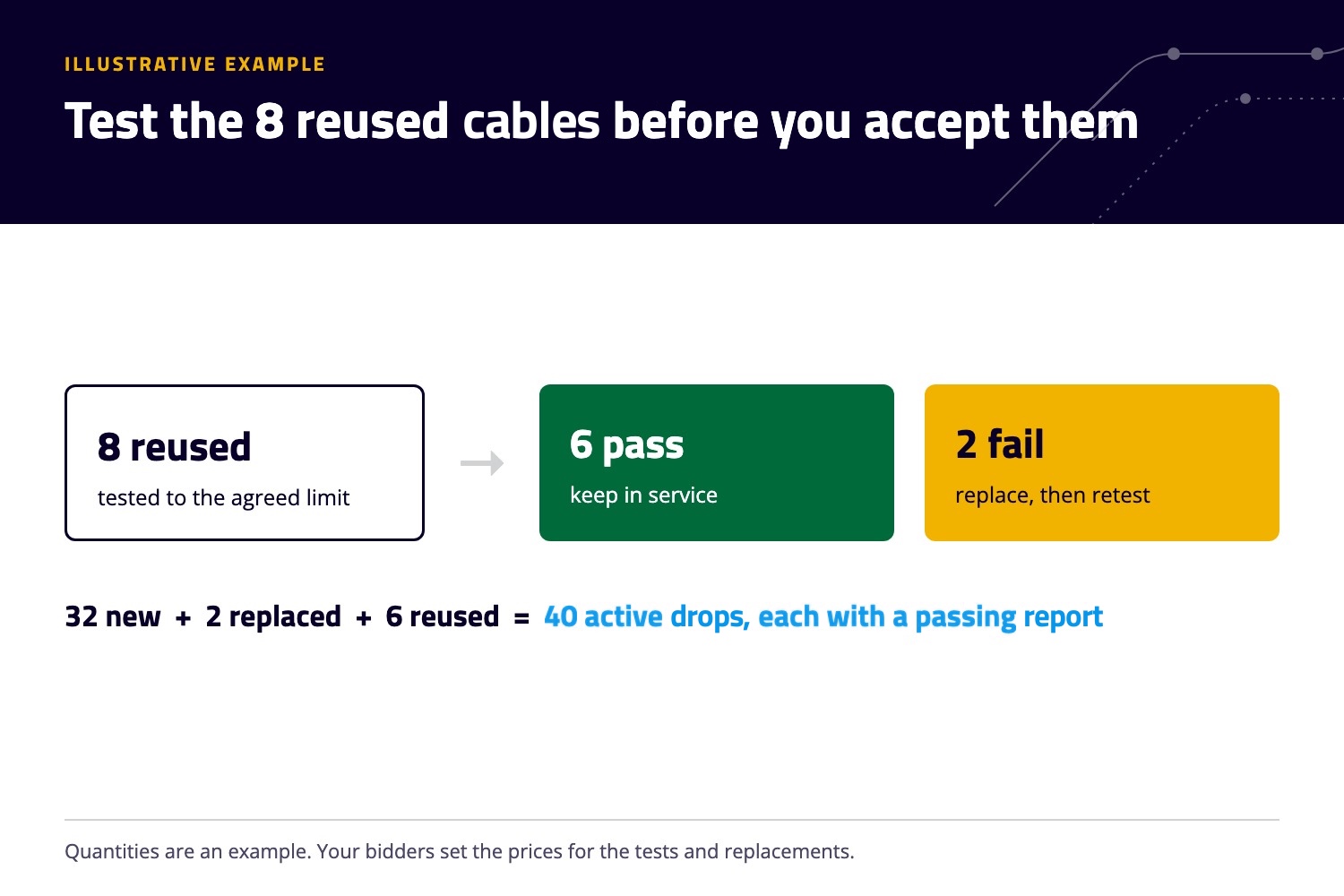
Say a tenant needs 40 active drops for a move-in, and eight existing cables already end where the new desks go. Bid A includes 40 new drops and a certification report for each one. Bid B includes 32 new drops and reuses the other eight, but only tests the new ones. Both deliver 40 physical connections. As written, eight of Bid B’s cables have no certification report.
Ask Bid B to add testing for all eight reused cables against the agreed test limits, plus a unit price to replace any that fail. Say six pass and two fail. Once the contractor replaces those two, the handoff should show passing results for 34 new cables and six reused cables. That’s 40 active drops.
Bid B’s extra cost is then the agreed testing charge for eight drops plus two approved replacements. Any access charge should be its own line. Compare that total with Bid A before you approve the work. These quantities are only an example, and the prices come from your bidders.
Use the same approach for every other exclusion. A contractor may price the job on the basis that the building has a clear pathway and allows access during the quoted hours. Ask what happens if the path is blocked or the building only allows evening work. If you manage the property, you control much of this, so settle it before bids come in. Either way, get the price and schedule change in writing before you approve it.
Agree on the test and the proof before work starts. A basic continuity or wire-map check finds wiring faults, such as an open or crossed wire. Certification goes further: it measures how each cable performs against the test limit for its category. For a standard fixed copper cable from a patch panel to a wall jack, ask for permanent-cable certification at the specified category.
A channel test also counts the patch cords at each end, so it measures something different. Fiber Optic Association copper testing guide · Fluke Networks on link and channel testing · Fluke Networks on test types
Ask for the cable ID, test limit and final result for each accepted cable run. The cable ID should match the wall-plate label, the patch-panel schedule and the drawing. That way the tenant’s IT team can trace any port after move-in. If a cable fails and the installer repairs it, ask for the passing retest under the same cable ID.
Get the full results as a PDF. If the tenant’s IT team also wants the original test files, say so up front. Fluke Networks cable test reporting
If you manage the building, set the work window and telecom-room access rules before bidders price the job. If you’re the tenant’s facilities lead, get those rules from building management first. For work inside Santa Monica city limits, check permit or plan-review questions with the City’s Building and Safety team. If the project needs an approval, put in writing who applies, who pays the fees and who handles inspections.
For an office elsewhere in LA, such as Culver City or El Segundo, check which city or county office covers the address. City of Santa Monica business guide · Santa Monica permit portal
Outlets and circuits for a network rack are electrical work. On their own, they go to the building’s electrical contractor, or to the GC’s electrician on a build-out. On a combined job, name who owns the cabling and who owns the electrical work, and check each trade’s license classification.
Ask for the bidder’s legal name and license number, then look up the record before signing. California low-voltage classification · California electrical contractor classification · California contractor license lookup
Give every contractor the same floor plan, port count, move-in date and building access rules. Ask each one for a base price and a price for each optional item. Also ask for the assumptions that could change those prices, and what the tenant’s IT team gets at handoff. Then every proposal covers the same scope, and the totals mean the same thing.
At a large business park in Santa Monica, we’re the go-to low-voltage and IT provider for the property. Our structured cabling team designs and installs commercial cabling and provides certification reports for the data drops we install. We also run the systems on that cable and support them after move-in, so the tenant and the building have one company to call.
Send us your floor plan and move-in date. Tell us if any existing cable needs to stay in service, and whether another trade already owns the pathways or power. We’ll come back with a scope and a price, broken out the same way as the table above.
An allowance is a set amount held for work nobody can count yet. Ask what it covers and how it gets settled at the end of the job. Get the assumed quantity, the unit price and the name of the person who can approve extra work, in writing.
Yes, if you accept them at handoff. Ask for a certification report and a label for each spare. A tested spare can stay unplugged at the switch until the tenant’s IT team needs it.
Put the exact model in the bid request. Ask the contractor to confirm it works with the specified cable and test limit. Agree up front who replaces it if it arrives damaged or late, or turns out to be the wrong part.
Both. Building management knows the risers, telecom rooms, work hours and approved trades. The tenant’s IT team knows the port count, the network gear and the move-in plan. Put both sets of facts in the bid request so every contractor prices the same job.

Nathaniel Belltree is President and CEO of Nascient Networks. He started Nascient Networks in 2020 as a low-voltage contractor in Los Angeles. Today the team pulls the cable, installs the systems that run on it and supports them afterward for commercial buildings and campuses across Greater Los Angeles.